
All Clear
A Blood & Steel Short Story

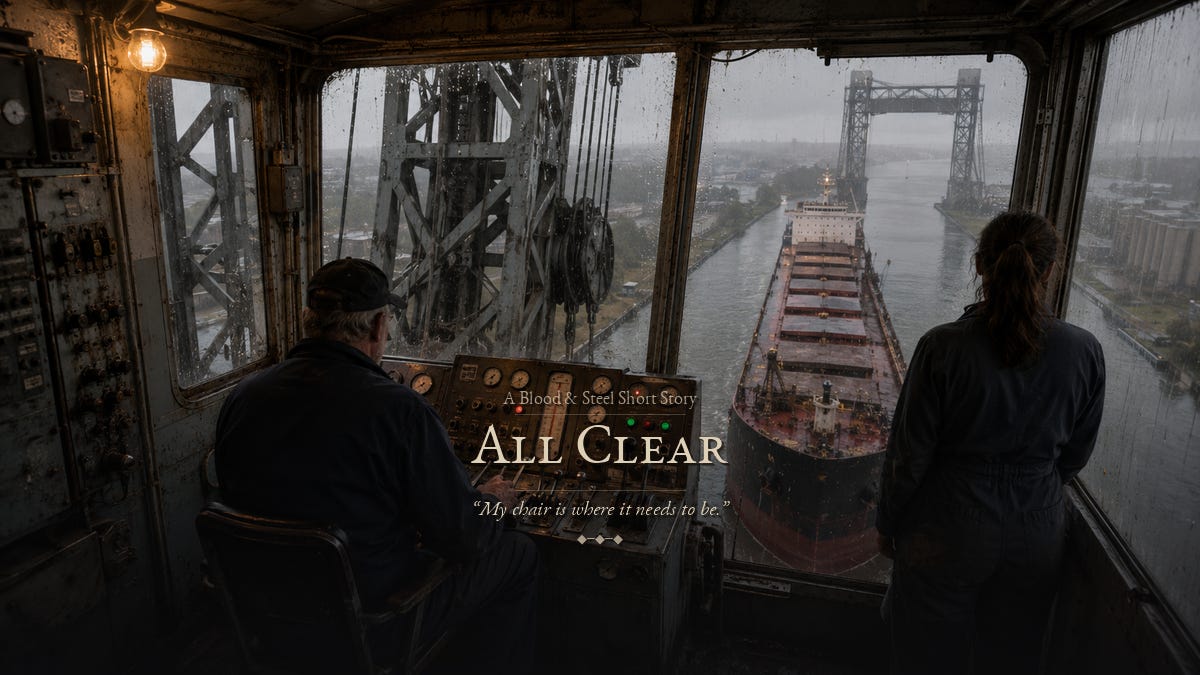
2146.291 · 15:47 | Gate 20, Hammison Locks
Gate Twenty had been old when Harris first learned to listen to it.
Thirty-two years later, the bridge had acquired new complaints without surrendering many of the old ones. The south gearbox knocked twice under a cold load. The north barrier relay sometimes needed an extra second to seat. Wind out of the east made the upper guide shoes chatter through the final six feet of lift, though only below forty degrees.
Today’s rain had brought out nearly all the rest. It moved across the Kyjorh Canal in gray sheets, blurring the highway and rail approaches on either side of the water. The operator’s house sat above both lanes at the south end of the lift span: a glass-walled steel box with room for two chairs, a control console, and a bank of relay cabinets occupying most of the rear wall. Every closed circuit produced a mechanical strike somewhere inside those cabinets. The console needles answered to pressure, current, rotation, weight.
He sat hunched over the maintenance ledger, one scuffed black boot hooked beneath his chair. The sleeves of his coveralls were rolled to the elbows over a faded black undershirt. His forearms remained lean and corded, veins raised beneath weathered skin.
Thirty-two years of reaching into places machines were not designed to let a man reach.
Bailey stood at the north window, reading the inspection board mounted beside it.
“You left the north-head line open again.”
Harris did not look up. “Weather hold.”
“It was a weather hold last week.”
“Rained last week.”
“It didn’t rain Monday.”
“North ladder was wet.”
“It was wet because it rained Sunday.”
Harris drew a line through the morning barrier inspection while Bailey waited.
Her ponytail was already coming loose at one temple: the kind that would catch on a ladder rung before the day was out. Twenty-two years old and still new enough to believe a maintenance schedule described the work instead of the argument required to get it done.
“You volunteering?” he asked.
“I’m not certified for tower-head inspection.”
“Then there we are.”
“You could take me up.”
“I could also throw myself down the stairs and save us both the time.”
“Your knees aren’t that bad.”
“My knees are older than you.”
“So is the bridge.”
Harris glanced up at her. She pointed to the blank inspection line.
“Quarterly became twice yearly. Twice yearly became whenever you can climb it. They sent me because you said you needed help.”
“I said I needed a qualified second operator and a maintenance crew.”
“They sent me.”
“They sent me an apprentice.”
“You’re welcome.”
Harris looked back at the ledger before she could catch the smile.
Beyond the rain-streaked glass, the canal ran south toward Bethshelm. Once, three or four loaded carriers had passed Gate Twenty every day. Ore went south to the mills. Coal, machine parts, and finished steel came north. Trains filled the gaps between bridge openings, and truck traffic stacked beyond the distant warning lights.
Now the canal could go days without a vessel, and Bailey watched the empty approach.
“Hard to justify all this for two ships a week.”
“One ship carries what three ore trains do.”
“Then why are you complaining?”
“Because we maintain a bridge, a lock approach, two towers, the highway signals, rail blocks, and half a mile of channel lights so one captain can inconvenience everyone on the road.”
“One captain and forty hands.”
“For cargo the rail could move.”
“Maybe. Ask me after I’ve seen a train do it.”
Bailey tapped the inspection board instead of pressing him further. “Manual lists this as a Tier Two crossing. Tier Two gets a crew of six.”
“Manual’s nineteen years out of date.” Harris did not look up. “Gate Twenty came off the active roster before that manual was printed. Officially, we don’t exist. Nobody’s ever come out to finish the paperwork on shutting us down.”
Bailey wrote that down too, though it did not belong on the sheet.
“You ever worry about the fever getting out this far?”
“At my age, I worry about everything. Fever’s just better organized about it.”
The bridge-set speaker crackled.
Harris’s boots came down as the voice arrived through static, steady and familiar.
“Gate Twenty Lift, Gate Twenty Lift, this is motor vessel Iron Grace, southbound for passage. Two miles above the approach.”
Harris closed the ledger.
“Iron Grace,” Bailey said. “Mayword?”
“Who else would come through in this?”
“Someone with a better schedule.”
“Captain Mayword has never had one of those.”
Harris pulled his work belt from the back of the chair and fastened it around his waist. Flashlight. Folding rule. Grease pencil. Adjustable wrench. Short pry bar. Utility knife. He checked each by touch, then lifted two portable valve radios from their charging cradles.
He switched both to channel three and tossed one to Bailey. She caught it against her chest.
“You’ve worked his passages a long time, haven’t you?”
“Twenty-one years.”
“And never met him.”
“He stays on his ship. I stay on my bridge.”
Harris sat at the console and keyed the main radio.
“Iron Grace, Gate Twenty Lift. Hold above the limit marker while we secure road and rail.”
“Gate Twenty, Iron Grace. Holding above the marker.”
Captain Mayword paused.
“Try not to drop anything on us today, Harris.”
He reached for the warning controls.
“No promises, Captain.”
Mayword’s laugh broke through the static.
Red lamps began flashing through the rain, first on the north approach, then the south.
“Last bulb walk?” he asked.
“Tuesday.”
“Do it again tomorrow.”
“They’re on a weekly schedule.”
“The feedback circuit tells us the circuit closed. It doesn’t tell us every bulb lit.”
Bailey opened the ledger and wrote it down while Harris closed the warning circuit.
Gongs began at the barrier posts, north and south. The south rang clean. The north came in late and thin, a full strike behind its lamp.
“North gong again,” Bailey said.
“Put it on the sheet.”
“It’s on last month’s sheet.”
“Then put it on tomorrow’s.”
A tanker truck approaching from the south slowed. Two freight haulers coming from the north followed suit. Harris waited until he saw brake lights before lowering the near barriers. The heavy arms settled across the roadway.
Bailey called Hammison dispatch on the hard-line telephone and requested the rail block. While she read back the dispatcher’s code, Harris watched a northbound truck roll to a complete stop beyond the distant flashers.
“Rail block confirmed,” Bailey said.
“North approach.”
Bailey took the field glasses down from the hook beside the north window while Harris pulled his own from the console rack without looking for them.
They raised them together.
Rain crossed the north approach in long sheets. The distant flashers turned red beyond the trees, and past them the roadway ran empty into the weather. The two freight haulers sat nose to tail short of the barrier arm, running lights on, wipers going.
“Both haulers stopped at the near barrier,” Bailey said. “Nothing behind them to the flashers.”
He held the glasses a moment longer.
“Nothing behind them to the flashers. All clear to the north.”
“All clear to the north.”
They turned together and crossed to the south glass.
“South approach.”
The tanker had come to rest twenty feet short of the south arm, its load drum streaked with rain. Beyond it the roadway climbed empty toward the curve, and the far flashers turned in the gray.
“Tanker’s down and holding,” Bailey said. “Roadway clear to the curve.”
Harris tracked the entire approach himself: barrier, shoulder, curve, flashers.
“Roadway clear to the curve. All clear to the south.”
“All clear to the south.”
He set the glasses back in the rack and wound the brass interval timer beside the lift controller. Its red hand swept around the dial.
“Warning period begins.”
He keyed the radio.
“Iron Grace, Gate Twenty. Road and rail secured. Lift begins in six-zero seconds.”
“Taking your time today.”
He watched the timer.
“Make it nine-zero.”
“I believe that would violate your procedure.”
“It’s my procedure.”
The timer bell rang.
He placed one hand on the controller.
“Bridge clear?”
Bailey looked through both banks of windows.
“Bridge clear.”
“Withdraw lower locks.”
She pulled the long lever. Beneath the roadway, two steel bolts retracted from the fixed approaches with separate, heavy blows.
“Locks withdrawn.”
“Release machinery brakes.”
“Brakes released.”
“Begin lift.”
The relay cabinets struck in sequence, ozone sharp behind them.
The north motor started first. The south answered a fraction later. Reduction gears took the load with a deep metallic knock that traveled through the span and into the operator’s house.
Inside each tower, a concrete counterweight descended its shaft as the bridge rose. Guide rollers turned against steel rails. Wire ropes tightened across the great sheaves at the tower heads.
The floor trembled beneath Harris’s boots.
The windows chattered.
Bailey caught the edge of the console.
“Does it always shake like this?”
Harris leaned back and hummed beneath the machinery.
“Mostly.”
“That isn’t reassuring.”
“It isn’t meant to be.”
The south motor ammeter climbed to its usual load.
The north climbed higher.
Six divisions higher.
Harris stopped humming.
Bailey’s head came around.
“North load.”
“I see it.”
The needle remained high as the bridge passed twenty feet.
Harris listened.
The north drive sounded rougher than the south, but it had always sounded rougher. Beneath the gearbox note came a low pulse: the old sheave bearing complaining under load.
He tapped the ammeter glass with the shortened finger of his left hand.
The needle dropped below the south, wavered, then climbed back to rest two divisions above it.
“Movement’s dragging,” he said. “Put in an order.”
“For the gauge?”
“Two-hundred-amp movement. They’ll send the whole casing if you don’t specify.”
Bailey did not write.
“You’re sure it’s the gauge?”
He listened to the north tower.
The bearing’s pulse sat where he expected it. No grind. No scrape. No change in rhythm.
“Motor sounds right.”
“It’s still reading high.”
“Two divisions. That’s the movement.”
“It moved when you hit it.”
“That is generally what happens when a needle sticks.”
“You said machines complain for a reason.”
“I said listen when they complain.”
“And?”
“And I’m listening.”
The span climbed through forty feet.
The counterweights descended within the towers, their guide rollers humming behind the steel lattice. The north side produced its familiar uneven note. Harris matched his breathing to it until Bailey’s attention returned to the height indicators.
Sixty feet.
Seventy.
At seventy-six, a faint vibration passed through the north side of the console.
Bailey lifted her hand from it.
Harris saw her look at him.
“East wind,” he said.
“There isn’t any wind.”
“There will be.”
The full-open lamps appeared at eighty-two feet.
The motors wound down. The sound of the lift thinned to rain on the roof and the ticking of cooling metal.
“North height.”
“Eighty-two feet.”
“South.”
“Eighty-two.”
“Skew.”
Bailey checked the narrow central dial.
“Centered.”
“Full-open limits.”
“Both made.”
“Set brakes.”
She moved the lever. Two lamps changed behind the console glass.
“North brake set. South brake set.”
“Upper dogs.”
She pulled the latch lever.
Two heavy impacts traveled down from the tower heads as the full-open safety dogs seated beneath the span’s lifting shoes.
“North engaged. South engaged.”
“Lamps aren’t a dog,” Harris said. “Glasses.”
Bailey still had hers. Harris took his from the rack.
Together they looked north, up through the lattice to the tower head, where the latch mechanism sat black and wet against the gray. The dog had driven fully home beneath the lifting shoe. Rain streamed from its upper surface.
“North dog seated,” Bailey said. “Full travel.”
“North dog seated, full travel.”
They turned and put the glasses on the south tower head.
“South dog seated. Full travel.”
“South dog seated, full travel.”
Harris lowered the glasses and looked down through the rain at the channel, at the empty gray water running between the protection fenders, at the signal lamps he had not yet turned green.
“Channel.”
“Clear below.”
“Clear below,” Harris said, and set the glasses back in the rack.
He changed the channel lights from red to green.
“Iron Grace, Gate Twenty Lift. Span at full lift. Channel is open. Proceed center channel, six knots over the bottom.”
A pause on the circuit.
“Gate Twenty, Iron Grace. Proceeding center channel.”
Harris waited.
The acknowledgment did not come.
“Iron Grace, confirm six over the bottom.”
“Confirmed, Gate Twenty.”
A long horn blast rolled through the rain.
Harris hooked his boots around the chair legs and let his weight settle back. The tuneless hum returned.
Bailey stayed at the north glass with the field glasses.
“How long does this take?”
Harris drew the watch from the breast pocket of his coveralls, pressed the crown, and laid it faceup on the console beside the radio. He had timed every southbound carrier with that watch since before she was born.
“Marker to the bend, six minutes. Bend to the fenders, eleven more. Ten after that to clear the span and lower approach.”
“Twenty-seven minutes.”
“Give or take.”
“For one ship.”
“For one ship.”
Bailey lowered the glasses.
“Earlier. You never answered me about the rail.”
“The grades out of Kyjorh punish heavy consists. You can move ore by rail. You cannot move that much ore by rail on a Tuesday because somebody decided he wanted it on a Tuesday.”
“So the ship wins.”
“The ship is slower. The cargo isn’t.”
“Ships wait for weather.”
“They do.”
“And locks.”
“Yes.”
“And an aging bridge operator who spends half the day arguing with his apprentice.”
“That is the worst of it.”
She raised the glasses before he could see her smile.
The Iron Grace came around the bend.
The canal made the vessel look too large for the land around it. Dark hull. Red lower plating riding low in the water. Forward cargo hatches running nearly the length of the deck. Stern accommodations rising above the rain like a block of buildings set adrift.
“She’s heavy,” Bailey said.
“Four trains today.”
“You can tell?”
“Look at the load line.”
Harris glanced at the watch on the console.
Four minutes and change.
He looked out at the water for a moment without speaking.
Then he keyed the main radio.
“Iron Grace, Gate Twenty. Six over the bottom through the approach.”
The circuit remained open a moment before Mayword answered.
“I’m already behind schedule, Gate Twenty. Are you telling me how to run my ship?”
“Procedure, Captain. Procedure.”
“Understood.”
The carrier did not slow.
He returned the microphone to its clip.
Bailey waited for him to key it again.
He picked up the grease pencil instead.
“Is he going to slow down?”
“He’s inside his water.”
“That isn’t what I asked.”
Harris drew a line through the passage entry and wrote the time beside it.
“No.”
Bailey watched the ship a while longer.
“So which is better?” she said. “Rail or water?”
“Whichever one is moving today.”
A metallic snap came from the north tower.
Harris turned.
The sound was clean and sharp, like a rifle fired inside a steel drum.
The skew needle shifted half an inch toward NORTH LOW.
“North dropped,” Bailey said.
“Half an inch.”
The north dog-lamp remained green.
The north machinery-brake lamp remained green.
Harris reached for the controller.
Another snap sounded.
The north dog-load needle swung hard to the right as the span’s weight came off the ropes and settled onto the latch.
A rope alarm began striking inside the console.
“What was that?” Bailey asked.
“First rope.”
He keyed the marine radio.
“Iron Grace, Gate Twenty. Emergency stop. Full astern. Do not enter the span.”
“Gate Twenty, Iron Grace. Full astern.”
The ship’s horn sounded twice.
White water boiled behind the stern.
The carrier continued forward.
“Bailey. Glasses. Where is she.”
Bailey had them up before he finished.
“Past the limit marker.”
“How far off the fenders.”
A pause.
“She’s coming in too fast.”
Harris did not look away from the panel.
“How fast.”
“I don’t—”
“You’ve been watching her since the bend. How fast.”
“Eight.” Bailey’s voice changed on the second word. “Maybe nine.”
The rope alarm continued striking.
He keyed the radio.
“Iron Grace, confirm full astern.”
“Full astern, Gate Twenty. Both anchors are going.”
Mayword said nothing else.
The circuit remained open for a moment, then closed. Rain continued against the roof.
The skew reached an inch and a half.
Harris released the north brake and engaged the raise circuit.
The north motor contactor slammed closed.
The ammeter drove into the red.
Nothing moved.
The tower-head bearing had seized.
The sheave above them no longer turned. The motor kept pulling against it, and the rope groups absorbed the difference, slipping in their grooves and loading one another unevenly.
The north tower stopped singing.
Harris stopped with it.
Now he understood the six divisions.
He had written the order for a gauge.
“Cut the drive,” Bailey said.
He returned the controller to neutral.
The contactor opened.
Too late.
A third crack traveled down through the tower.
Several smaller cracks followed in quick succession.
The north counterweight dropped.
Harris heard it run inside the tower shaft: a descending thunder behind the lattice, guide rollers hammering against their rails as the concrete mass accelerated.
“North weight is loose.”
The counterweight struck the lower buffer.
The impact shook the entire bridge.
Glass rattled in its seals. The console jumped beneath Harris’s hands.
The north upper dog tore free.
Its green lamp vanished.
The north end of the span dropped six feet.
The control house lurched forward and sideways. Bailey struck the relay cabinet. Harris caught the lift controller with both hands and remained upright only because his work belt snagged the corner of the chair.
Outside, the bridge’s north guide assemblies tore away in a chain of metallic blows.
The skew needle slammed against its stop.
For several seconds, neither height dial gave a usable reading. The north pointer spun downward. The south remained fixed at eighty-two feet.
The geometry was gone.
Harris seized the radio microphone.
“Iron Grace, stop your approach.”
“We are full astern.”
“Where are your anchors?”
“Dragging.”
The carrier’s bow wake collapsed as the engines fought its momentum. The vessel slowed, but the channel gave it nowhere to turn and too little water to stop in.
Bailey pushed herself away from the cabinet.
“What failed?”
“North head.”
“The bearing?”
“Bearing, sheave, ropes. Doesn’t matter now.”
“We need maintenance.”
Harris looked at her.
“The bridge is gone.”
She stopped.
He pointed through the glass at the vessel below.
“That ship has forty people aboard. Our job changed.”
The north end continued downward, slower now, hanging from damaged ropes and what remained of the guide structure.
The south end did not move.
The south upper dog still held the span at full height.
A deep pop traveled through the floor beneath Harris.
Then another.
“What’s that?”
He moved to the south window.
The span hung diagonally over the canal, its north end falling while the south remained locked against the tower. The bridge had become a lever nearly three hundred feet long. Every foot the north side fell multiplied the force twisting through the south dog, the span chords, and the tower connection beneath the operator’s house.
“South is still pinned,” he said.
“That’s good.”
“No.”
Another connection popped beneath them.
Harris pointed through the glass.
“North is pulling down. South dog is holding us up. Keep that leverage on the span and it’ll snap us like a toothpick.”
Bailey watched the north end sag lower.
“What happens if it breaks?”
“Best case, the center folds and drops into the channel.”
“And worst?”
“It rolls sideways, takes this tower with it, and cuts that ship open from bow to wheelhouse.”
The floor shifted.
A seam opened across the ceiling above the relay cabinets.
“What do we do?”
“We release the south dog.”
“That’s the only thing keeping us up.”
“It’s the only thing keeping us from following the north.”
“That sounds like the same thing.”
“It isn’t.”
Harris sat at the controls.
“If we keep fighting the north, the span tears itself apart. We release the south dog, take the leverage off, and walk this end down behind it.”
“Can the drive hold us?”
“For a while.”
“And then?”
Harris looked at the approaching carrier.
“Then we decide where the bridge lands.”
He keyed the main radio.
“Iron Grace, Gate Twenty. North side is gone. South is still locked, but the leverage is tearing the span apart.”
Mayword’s reply came through the static.
“What are your options?”
“I release south and follow the north end down.”
“You can lower the span?”
“I can control this side.”
“How far?”
“Until the brake or drive gives out.”
Mayword did not answer.
A rivet let go somewhere below them, sharp and quick.
Harris could hear voices in the wheelhouse behind him.
“Captain?”
“You are asking me to put forty people beneath a falling bridge.”
“I’m telling you the bridge is falling either way.”
“I can put her into the east bank.”
“You ground there and the span rolls through your stern accommodations.”
“I might stop short.”
“You won’t.”
Static filled the control room, and something gave beneath it, a duller crack further down the span.
Mayword’s voice returned, quieter.
“Where do you need us?”
“Forward holds beneath the center span. Keep your wheelhouse and crew spaces aft of the impact.”
“You believe the hatch deck will carry it?”
“No.”
Another steel connection gave beneath Harris’s feet.
“But it will carry more than your wheelhouse.”
Mayword breathed once into the microphone.
“Understood.”
His voice turned away from the radio.
“All hands aft. Clear the forward deck. Bow west, thruster full.”
“Work harness,” Harris said.
She pulled the climbing harness from beneath the console and stepped into it. Her hands moved too quickly. One webbing tail remained outside its keeper, and the portable-radio cord crossed over the loose strap.
“Turn around,” Harris said.
“We don’t have time.”
“Turn around.”
Bailey did.
He threaded the tail through its keeper, tightened the waist buckle, and routed the radio cord beneath her shoulder strap. He checked the snap hook and tugged the belt hard enough to move her.
Then he unclipped the adjustable wrench from his own belt and hung it from hers.
“Loose ends catch ladders.”
“I know.”
“Then don’t climb with one.”
The bridge shifted again.
“What am I doing?”
“South tower. Manual dog cabinet.”
Her face changed.
“The remote release won’t work under skew.”
“The interlock won’t allow it.”
“So I open it at the tower.”
“You open the cabinet and pull the mechanical release.”
She looked through the south glass at the narrow catwalk connecting the raised span to the tower platform.
“Why me?”
“One of us has to climb the tower.” Harris flexed his right knee. The joint answered with a dull grind.
“You were complaining about those knees before the ship called in.” Bailey was already checking her harness buckle. “I’ve got this.”
Harris opened his mouth, then closed it.
“Channel three.”
She switched it on.
“Bailey to Gate Twenty.”
Her voice came through the portable at his belt.
“Gate Twenty receives.”
He opened the emergency hatch.
Rain blew into the control room.
The catwalk trembled beyond it.
Bailey clipped her safety line to the rail.
Harris caught the back of her harness before she stepped out.
She turned.
He pointed toward the south controls.
“North has already taken the bridge. We still own this side.”
“I’m not certified for this.”
“You’re certified now.”
Bailey looked at him for a moment.
Then she nodded.
“Tell me when.”
“Get there first.”
He released her.
Bailey moved across the catwalk, her boots finding the wet grating without looking down.
Harris watched her clear the first joint before he allowed himself to look away.
He went back to the console.
The Iron Grace continued beneath them, engines churning astern. Its bow shifted west by degrees, responding slowly to the thruster and rudder. Crew moved along the deck toward the stern, dark figures against wet steel.
The north end dropped another foot.
The south remained fixed.
The span tore somewhere below the roadway.
“Bailey?”
“Across the catwalk.”
“Get into the tower.”
She reached the ladder and clipped onto the fixed safety cable.
“Starting up.”
The manual dog cabinet sat one platform above her, bolted to the tower frame near the full-open latch mechanism.
He watched the south dog-load indicator.
The needle climbed.
He keyed the marine radio.
“Mayword, keep your bow west.”
“I’m going to hit the protection fender.”
“That is what it’s there for.”
“Not at this weight.”
“Today it is.”
The Iron Grace shifted toward the west fender.
Above it, the north end of the bridge continued downward.
Bailey’s voice returned through the portable.
“At the cabinet.”
“Open it.”
A pause.
“It won’t move.”
“Turn the latch,” Harris said.
“I did.”
“Use your shoulder.”
Metal thudded through the radio.
“It’s painted shut.”
Harris looked toward the annual inspection line in the ledger.
The manual cabinet had once been opened every year. Then every two. The last recorded inspection was eleven years old.
“Break the seal.”
“With what?”
“The wrench on your belt. Hit the upper hinge.”
“Hinge isn’t the problem. Rust sits thickest where water pools. That’s the bottom seam, not the top.”
“Hit the hinge, Bailey.”
Three strikes came through the radio before he finished saying it.
Low, all three.
Metal shrieked. The door gave.
Harris sat back from the console.
“I’ll be damned.”
“I’m in.”
“Find the red retaining pin.”
“I see it.”
“Pull it.”
She grunted.
“Won’t move.”
The south dog carried the weight of the entire twisted span. The release pin had bound beneath the load.
He placed one hand on the south brake.
“I’m going to raise you half an inch.”
“You’re raising the bridge?”
“This end.”
“Can the drive do that?”
“We’re about to find out.”
He released the south machinery brake.
The dog took the full load.
The indicator needle struck its stop.
He engaged the south raise circuit.
The motor contactor closed.
The ammeter climbed into the red.
The tower shuddered.
For a moment, the south height needle did not move.
Harris heard the motor strain.
Then the pointer rose half an inch.
“Now, Bailey.”
She pulled.
The retaining pin came free.
“Pin out.”
“Release lever.”
The lever resisted.
Bailey put both hands on it.
“Put your back into—” Harris began.
“Stubby. Shut up for one second and let me listen.”
Harris shut up.
Her voice returned, steadier.
“It’s moving.”
“Keep going.”
The upper dog withdrew from beneath the lifting shoe.
The south end settled onto the machinery brake and drive gearing.
“Dog clear,” Bailey said.
“Confirm.”
“Fully withdrawn.”
“Get behind the tower brace.”
“What about you?”
“Brace, Bailey.”
She hesitated.
“Harris—”
“Move.”
Bailey clipped into the protected side of the tower and crouched behind the main brace.
Harris keyed the marine radio.
“Iron Grace, south dog is released.”
“Understood.”
“I’m bringing our side down.”
“We are moving into position.”
Harris set his left hand on the lowering controller and his right on the machinery brake.
The north side had fallen too far to recover. He could not level the bridge. He could only keep the difference from widening until the ship was beneath them.
He eased the brake.
The south end descended several inches.
The operator’s house dropped with the span. Tools rattled across the console. One drawer slid open and spilled a row of spare fuses onto the floor.
Harris set the brake.
The south dog-load needle fell to zero.
The skew remained buried against its stop, but the popping beneath the span slowed.
He lowered another six inches.
The bridge groaned through its length.
“Bailey?”
“Behind the brace.”
“Stay there.”
“I should come back.”
“The catwalk won’t meet the tower once I lower.”
“Then leave it.”
Harris looked down at the Iron Grace.
The carrier’s bow entered beneath the north half of the span. Its west side struck the protection fender with a low concussion that traveled through the water and tower foundations.
Timber cracked.
Steel folded.
The vessel slowed and began pivoting across the channel, bringing its forward holds beneath the bridge while keeping the stern accommodations clear.
He keyed the portable.
“That ship has forty hands.”
Bailey said nothing.
“My chair is where it needs to be.”
He released the brake again.
The south end followed the north.
Inches became feet.
The drive resisted the descending weight, motor turning under load while the machinery brake controlled its speed. Hot oil filled the operator’s house with a bitter smell.
The bridge no longer tried to roll sideways.
It was still falling.
But now it was falling toward the cargo deck.
Harris keyed the marine radio.
“Mayword, your first hold is beneath north.”
“I see it.”
“I need the second and third beneath center.”
“Bow is against the fender. We have no more west.”
“Keep your stern coming east.”
“If I give you more rudder, we lose the bow.”
“Give me what you can.”
The ship shifted.
Harris lowered the south end another foot.
The skew had stopped growing.
That was all he had won.
A violent crack came from the north tower.
The remaining rope groups parted.
The north end dropped again.
The height needle spun six feet before stopping.
The span buckled across its center.
The control house lurched forward. Harris struck the edge of the console with his ribs and fell against the chair.
Glass burst from the north windows.
Rain swept into the room.
The south machinery brake shrieked beneath the new load.
“Harris!” Bailey’s voice broke through the portable.
He pushed himself upright.
His ribs answered every breath.
“I’m here.”
“The center chord folded.”
“I can see it.”
“You can’t follow that.”
“I don’t need to.”
The north end now hung over the first cargo hold. The south remained above the third.
If Harris kept lowering, the bridge would land across the forward hatch deck.
If he stopped, the north end would pull the damaged span apart and roll the center into the ship.
He placed both hands on the controls.
“Mayword, this is the last adjustment.”
“What happens after?”
“I lose the drive.”
“That is not an answer.”
“It is the only one I have.”
He eased the brake.
The south motor howled.
The control house descended.
The bridge’s twisting eased as the south side followed the north. Damaged trusses ground against their guides. Rivets snapped beneath the roadway. Steel plates folded where the span had bent.
Harris watched the south ammeter.
The needle climbed beyond its rated load.
He did not tap it.
“Bailey, start down the protected ladder.”
“I’m not leaving you up there.”
“The catwalk is gone.”
“Then you climb down with the house.”
“My knees weren’t good before we dropped the bridge.”
“Stubby.”
“Start down.”
She remained behind the brace.
Harris looked through the rain toward her.
“Bailey.”
She clipped onto the tower ladder.
“Three points,” he said.
“I know.”
“Say it.”
“Three points on the ladder.”
“Go.”
Bailey started down.
He returned to the main radio.
“Captain, forward deck clear?”
“Clear as I can make it.”
“How many aft?”
“We’re still moving them.”
The bridge lowered another foot.
The Iron Grace filled the windows beneath Harris. Wet hatch covers stretched below the span. Crew gathered near the stern, some still running.
“Get them behind the fourth hold.”
“They are going.”
The south brake began vibrating beneath Harris’s hand.
The gearbox-pressure needle fell.
The ammeter remained above the red line.
He lowered the span another eighteen inches.
The control room descended close enough that Harris could see rain bouncing from the cargo hatches below.
“Mayword.”
“I’m here.”
“Hold your position.”
“We’re against the fender and full astern.”
“Good.”
“There is nothing good about this.”
Harris looked at the bridge, dimly reflected in the glass of the dead north gauge.
“No.”
The south gearbox gave a hard internal knock.
The ammeter dropped to zero.
The motor stopped resisting.
Harris tapped the glass once with his shortened finger.
The needle remained at the bottom.
The brake lever kicked beneath his hand.
The south end began to run.
Mayword’s voice cracked through the speaker.
“Oh my Gods.”
Harris pulled the brake lever with both hands.
It slowed the descent for less than a second.
Then the lining failed.
The bridge fell.
The north end struck the forward hatch deck first.
The impact drove the Iron Grace deeper into the canal and threw a wall of ore through the ruptured hatch covers. The hull tore away from the west fender and rolled east.
The center span folded across the second hold.
The south end followed.
Harris saw the deck rushing toward the windows.
Then the operator’s house hit.
The console tore loose from the floor.
It hit Harris across the thighs and drove him backward into the chair. Steel folded over his right leg. One corner of the roof collapsed, showering glass and fragments of relay board across his shoulders.
A second impact traveled through the wreck as the carrier’s stern struck the east protection wall.
Then the bridge stopped moving.
Harris remained conscious.
He was not certain that was an advantage.
Rain entered through the broken windows and ran across the tilted floor. The relay cabinets had opened like metal books. Wires hung from them in loops, carrying no current.
His right leg was trapped beneath the console. He could not feel his foot.
Breathing hurt.
He reached for the portable radio.
It was gone.
The main bridge set lay crushed beneath part of the ceiling.
For the first time in thirty-two years, Gate Twenty had nothing to tell him.
Voices rose from the ship.
Men shouting names.
Metal being moved.
Someone calling for a medic.
Harris tried to lift the console from his leg. White light filled his vision, and he stopped.
He leaned back.
Above the ruined south window, Bailey appeared on the tower platform.
She leaned over the railing.
“Harris!”
He raised his left hand.
Bailey covered her face with both hands for half a second. Then she disappeared toward the tower stairs.
The first crewman reached the control house from the forward deck. He climbed through the broken window, took one look at Harris’s leg, and called for lifting bars.
“Captain?” Harris asked.
“Wheelhouse is standing.”
“How many?”
The man looked at Harris’s leg instead of answering.
More crew arrived. They cut away part of the console and wedged bars beneath its frame. Each movement sent pain through Harris’s hip and ribs.
Bailey reached the ship before they freed him.
She climbed across the collapsed truss and entered through the missing south wall. Her ponytail had come completely loose. Blood ran from one palm where the tower ladder had cut through her glove.
“You stayed,” she said.
“So did you.”
“You ordered me down.”
“You made it down.”
“You could have left the controls.”
Harris looked past her at the bridge lying across the cargo holds.
“Not yet, I couldn’t.”
The crew lifted the console.
Harris made no sound until they pulled his leg free.
Then the operator’s house narrowed around him, rain and steel turning black at the edges.
When his vision returned, he was lying on a cargo tarp stretched across the deck.
The bridge rested above and around them.
Its north end had crushed the first hold. The center lay folded across the second. The south operator’s house had struck the edge of the third hatch and remained there, broken open to the rain.
The span had not rolled into the accommodations.
The wheelhouse still stood.
A tall man approached from the stern.
His hands were rope-scarred and thick-knuckled, nothing like the voice on the radio had suggested. He was younger than Harris had imagined, though salt had begun to gather in the hair at his temples. His uniform coat was torn at one shoulder. Blood marked the side of his face.
For twenty-one years, Harris had known him only through static.
The captain knelt beside the tarp.
“Bailey?” Harris asked.
“Standing behind me.”
Harris turned his head far enough to see her.
Only then did he look back at the captain.
“How many?”
“We’re still counting.”
Harris closed his eyes.
Rain struck the cargo deck.
Boots moved around him.
Somewhere aft, a man answered his name.
The captain held out his hand.
“Trenton Mayword.”
Harris opened his eyes and took it.
“William Harris.”
Mayword’s mouth tightened.
“I know. It’s been in my passage book for twenty-one years.”
“Never seemed important over the radio.”
“No.”
Mayword looked toward the bridge spread across his ship.
“You dropped Gate Twenty on me, William.”
Harris turned his head toward the ruined west fender.
“You hit it first.”
Mayword laughed once.
It ended quickly.
Men were still calling names.
Before dawn, Authority crews barred the highway approaches. Rail workers fixed warning boards across the tracks north and south of Hammison. The canal lights remained dark.
A sign went up before the final muster was complete.
GATE 20
TEMPORARY CLOSURE
The black letters ran in the rain.
The sign remained there for forty-five years.