
Last Call
A Blood & Steel Short Story

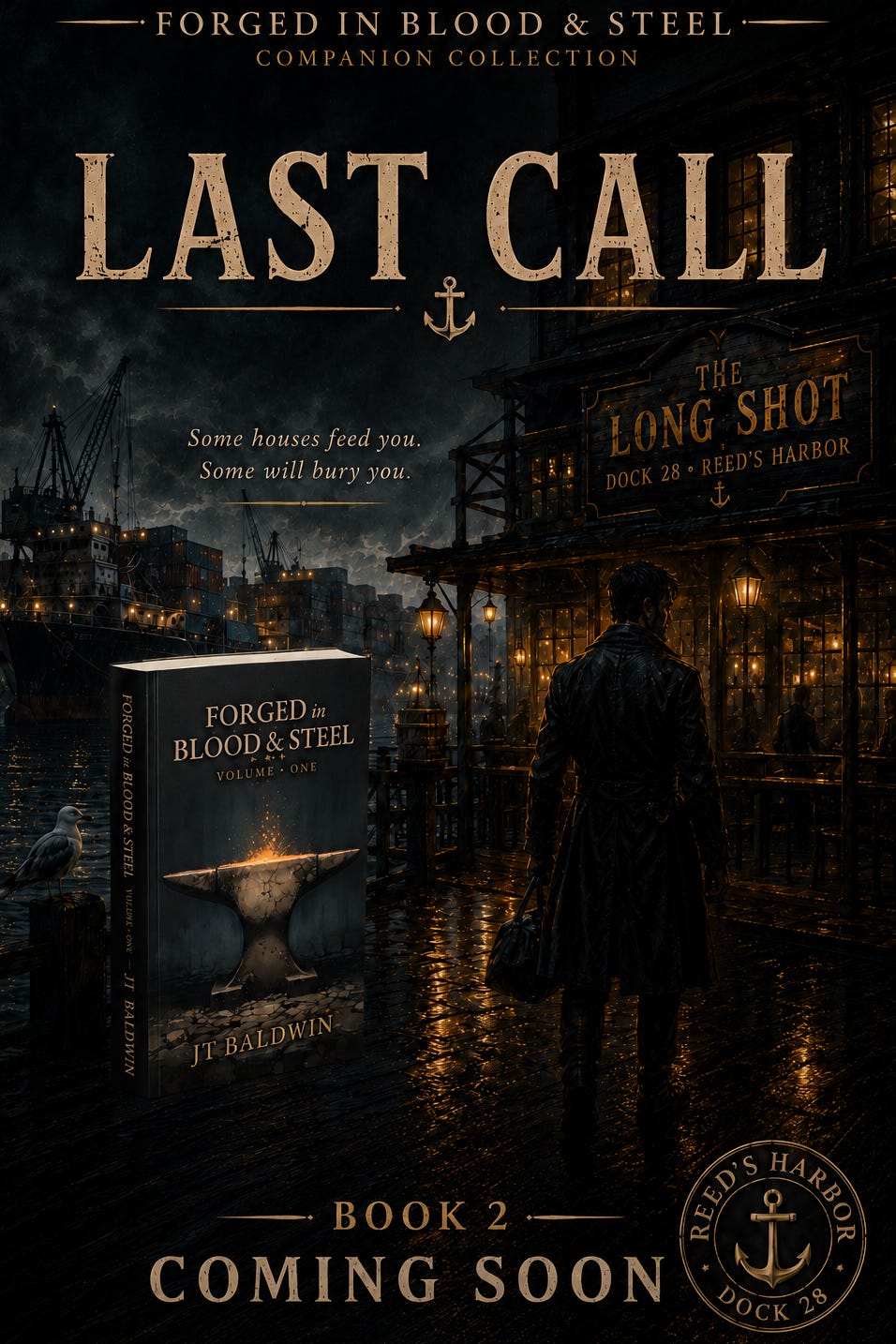
Early Spring | 2191.097 · The Long Shot
Dock 28, Reed’s Harbor
⛭
Rain had followed Kaelin Veyl three cities north and found him again at Reed’s Harbor.
It came in off the black water in cold sheets, needling through his coat, sliding under his collar, turning the boardwalk slick enough that every step wanted a little more attention than it deserved. Past the railings, the working dock kept moving because docks did not care about weather. Diesel winches coughed in the fog. A crane swung slow over the container stacks, its cable whining as another sealed box came off a barge and joined the others in their neat, rust-streaked towers.
Tourists liked that part from a distance.
They liked the romance of it. The boats. The gulls. The lamps burning yellow through the rain. They liked walking the boardwalk with paper cones of fried potatoes and cups of coffee gone bitter in the cold, pointing at the cranes as if the harbor had arranged itself for their entertainment.
Kaelin knew better.
The harbor had teeth. Everything coming in had a manifest. Everything going out had a price. Most people were only cargo that had learned to walk.
He paused under the striped awning of The Long Shot and wiped rain from his mouth with two fingers.
The sign above him swung on iron brackets, painted clean enough to be charming but old enough to look honest. A long, narrow building sat on the corner of the boardwalk like it had grown there instead of been built. Windows warm. Brass lamps polished. Flower boxes under the second-floor glass, though the flowers had not yet decided whether spring was worth believing in.
THE LONG SHOT.
Dock 28.
Rooms. Board. Credit.
Kaelin smiled faintly.
Credit was always the interesting word.
He pushed inside and let the warmth find him.
It hit first as smell. Bread. Beer. Kettle steam. Wet wool. Old varnish. Salt that had soaked into the floorboards long ago and refused to leave. The room was narrow from the street, wider toward the water, with booths along one wall and the bar along the other. A few dockhands sat near the back with their shoulders rounded over bowls of stew. Two older women played cards by the front window. A traveling couple argued quietly over a folded paper map, the sort sold at kiosks to people who thought streets obeyed ink.
Behind the bar stood a young man built like a dock piling.
He was tall enough that Kaelin noticed him before anything else. Broad across the shoulders. Thick forearms. Dark brown hair in need of a cut, damp at the ends, as if he had come in from outside recently and not bothered to dry himself properly. His eyes were dark too, soft around the edges. He had the kind of hands that could load cargo all day, then apologize to a chair for bumping it.
Useful hands.
Kaelin took off his cap, shook rain from the brim, and crossed to the bar.
The young man looked up. “Afternoon.”
“Depends who’s judging.”
That earned a brief smile. Not guarded. Not practiced. Real enough to be dangerous to its owner.
“Rough out there,” the young man said.
“Rough everywhere.” Kaelin set his cap on the bar. “Rain just makes it honest.”
The boy considered that as if it might mean something.
Good.
“What can I get you?”
“Something that remembers it was warm once.”
That got him the smile again, a little wider this time. The boy turned and took a bottle down from the second shelf. Not the cheap one. Not the expensive one. Middle shelf because he had been taught not to insult a wet stranger but not to be robbed by one either.
There was a mother in that choice.
Kaelin looked around while the boy poured. He noted exits, sightlines, room traffic. Front door. Side door marked PRIVATE beyond the end of the bar. Stairs near the back, likely rooms above. Kitchen through the half-swing door. A mechanical till bolted below the counter. No telephone behind the bar that he could see, though there was probably a wall line in the office. Ledger under the register. Cash drawer heavy enough by the sound of it when the boy nudged it shut for another customer.
Orderly place.
Too orderly for a dock.
“You local?” Kaelin asked.
“Born upstairs.” The boy set the glass down.
That was almost too good.
Kaelin let his eyes flick up, then back. “Here?”
“Room four, if Ma tells it right. Snowstorm. Midwife got stuck past Barrow Street. Dad says I was half out before she made the stairs.”
He said it with embarrassment, but not bitterness.
Not yet.
Kaelin wrapped both hands around the glass and let the heat settle into his fingers. “Hard thing, being born in the place everyone expects you to stay.”
The boy’s smile changed.
There.
Small. Quick. Buried almost before it lived.
Kaelin drank and pretended not to notice.
“What’s your name?”
“Randall.”
“Randall what?”
“Banks.”
Of course it was Banks. The sign had a small painted anchor worked into the word BOARD, and the same anchor had been stitched into the boy’s apron. Family mark. Family pride. Family cage.
“Kaelin Veyl.” He offered the name without the rank first, because names came softer without metal in front of them. “Passing through.”
“Most people are.”
“Does it bother you that you aren’t?”
Randall wiped the bar though it did not need wiping. “Somebody has to keep the place standing.”
“Didn’t ask what somebody had to do.”
The cloth slowed under Randall’s hand.
Rain tapped at the windows. From the dock side of the building, a horn blew low enough to stir the glass bottles against one another on the shelves.
Randall looked toward the sound. Not at the room. Not at the customers. Past them. Through them.
Kaelin followed his glance to the back windows, where the harbor showed in broken pieces between lamp glow and rain. Masts. Cranes. Stacked containers. A tug crawling along the channel with smoke dragging behind it.
“You ever work out there?” Kaelin asked.
“On the dock? Sometimes. When Dad needs extra hands. When Randi’s husband is short. When Pells breaks his back again and everyone pretends this time he’ll learn to lift with his knees.”
“Not what I meant.”
Randall’s gaze came back.
Kaelin tilted the glass just enough to catch lamplight along the rim. “Out there. Past the harbor.”
The boy’s face did what young faces did when the right door opened in the wrong wall. Nothing dramatic. No confession. Just the smallest rearranging of attention. He was still in the room, but some part of him had stepped toward the rain.
Kaelin had seen it in barracks. Rail yards. Mining camps. Farm towns with one road in and one road out. Boys built like men and treated like furniture. Boys who wanted someone to name the ache before they had to.
Randall leaned one forearm on the bar. “You military?”
Kaelin let the pause sit.
Not long. Long enough.
“Was.”
That was true in the way a broken cup was still a cup.
Randall lowered his voice a little. “What branch?”
“Delvaine field commission. Logistics attachment.” Kaelin reached inside his coat and drew the credential case enough for the brass corner to show. Not open. Never too eager. “Border stabilization. Freehold work. Ugly stuff, mostly. Necessary stuff.”
The boy looked at the brass.
Everyone looked at brass.
Kaelin turned it as if by accident, catching the yellow light across the insignia. Rank. Name. Seal. Enough to persuade a stranger. Not enough to survive a clerk who knew which forms spoke to which offices. But clerks were not his audience.
Randall swallowed.
“Are things bad?” he asked.
Kaelin almost admired the innocence of the question.
Things were always bad. The only variable was whether anyone had found a way to invoice the badness.
“Worse than people here want to believe,” he said. “Harbors make folks think the world is still connected. Boats in. Boats out. Coffee in the morning. Sheets changed upstairs. Same lamps lit every night. Feels sturdy.”
Randall glanced around The Long Shot, and Kaelin knew he had him.
“So it isn’t?” Randall asked.
Kaelin leaned closer. Not too much. Enough to make the conversation private without making it secret.
“Sturdy things break last. That’s the trick. People inside them think they’re safe until the walls are the only thing left standing.”
The boy’s hand tightened on the bar cloth.
Kaelin softened his voice. “Men are needed, Randall. Real men. Not parade uniforms. Not sons carrying trays until their backs go bad and their mothers still call them boys. Men who can move weight, follow instruction, keep their feet when the floor goes sideways. Men who want the world to ask something of them.”
Randall looked down.
There was shame there. Hunger too.
Kaelin kept his face open and calm, a veteran lending truth to a young man smart enough to hear it.
“I know some people,” he said. “Not enlistment halls. Better than that. Private contracts attached to serious work. Guarding freight. Escorting survey crews. Stabilizing bad roads before they become worse ones. Pay isn’t insulting. Food’s decent. Company’s better than most. Six months out, you come back with coin in your pocket and a spine no one here gets to pat like a house dog.”
Randall gave a short laugh at that, uncomfortable because it had landed too close.
“Ma would kill me.”
“Would she?”
The boy did not answer.
Kaelin did not push. That was the mistake amateurs made. They mistook pressure for leverage. Better to leave the shape of the key visible and let the lock want it.
“What kind of contract?” Randall asked.
There it was.
Kaelin rested his glass on the bar.
“Depends what you can do.”
“Lift. Haul. Fix most things that aren’t too clever. I can shoot, but not like Randi. I can keep books if I have to, but I hate it.” He flushed, realizing how much he had offered. “I mean, I help here.”
“Helping is what they call using you when they love you.”
Randall went still.
Too much, Kaelin thought.
Then the boy’s mouth pressed into a line, and Kaelin knew it had not been too much at all.
A woman’s voice cut across the bar.
“Randall.”
The boy straightened so quickly his hip struck the shelf behind him.
Kaelin turned.
The woman stood near the kitchen door with a stack of folded cloths in her arms.
Small. That was the first word his mind gave her and did not bother revising. She could not have been much over five feet. Gray threaded through the dark of her hair, pinned back severely enough that loose strands had surrendered. Her apron was clean but not new. Her sleeves were rolled to the elbow. She wore no jewelry except a plain band on one hand, and even that looked more practical than sentimental.
The room seemed to know her without needing to look.
“Ass in the back,” she said to Randall. “Help your father with the dishes. We’re getting behind.”
“Ma, I’ve got the bar.”
“I have the bar.”
“There are orders—”
“Dishes, Randall.”
The boy’s ears went red. For a heartbeat he looked exactly as young as he was. Then he tossed the cloth under the counter and pushed through the half-door toward the kitchen.
Kaelin watched him go.
Too cleanly removed. Not panic. Not interruption. Extraction.
Interesting.
The woman came behind the bar and set the folded cloths beneath the counter. She did not hurry. She did not ask what they had been discussing. She did not look after her son.
Then she turned to Kaelin.
“And you,” she said. “What do you want?”
Kaelin smiled.
The smile had opened doors from Port Franklin to Barrowfield. It had softened clerks, irritated husbands, reassured boys, flattered widows, and convinced men with more money than sense that Kaelin Veyl was exactly the sort of useful creature a hard world required.
“Depends what’s available.”
“Food, drink, rooms if you pay in advance, credit if I know your mother.”
“Dead.”
“Then pay in advance.”
He laughed because the line deserved it. “You always this warm to wet travelers?”
“I gave you a roof and didn’t charge for the rainwater you brought in.”
A few dockhands at the back chuckled into their bowls.
Kaelin adjusted his estimation.
Not soft, then. Sharp-tongued. Proprietor sharp. The sort of woman who could skin a drunk with words and still send him upstairs with a blanket after. Useful in a different way.
He set two coins on the bar. “Another, then.”
She looked at the coins, then at his glass, then poured.
No wasted motion.
Kaelin noticed hands. He always noticed hands. Hers were small, dry, and nicked from work. A burn near one knuckle. Flour caught at the edge of a nail. No tremor when she tipped the bottle. Nothing remarkable.
Still, the boy had vanished too quickly.
“Mrs. Banks?” he asked.
“Daelia if you’re polite. Mrs. Banks if you want me checking the spoons after you leave.”
“Daelia, then.”
Her expression did not change, but something in it declined the intimacy.
He lifted the glass. “Good place you have.”
“I know.”
“Good people too.”
“I know that better.”
There it was. The wall.
Kaelin did not mind walls. Walls told you where the gate might be.
“I may have given the wrong impression with your son.”
“My son forms impressions all by himself. Poorly sometimes, but he manages.”
“Randall’s a strong young man.”
“He has mirrors.”
“He’s wasted behind a bar.”
That landed.
Not visibly. She kept drying the counter with one of the folded cloths, though the counter had already been dry.
“He’s fed behind one,” she said. “Warm behind one. Annoying behind one. All things I’ve grown attached to.”
Kaelin let the smile turn rueful. “You think I’m here to steal him.”
“Aren’t you?”
“Offer him a road.”
“Same thing, depending who owns the road.”
Better than expected.
Kaelin leaned back on the stool. The height gave him an angle over her. It was useful. People reacted differently when they had to look up, even a little. He opened his coat enough that the credential case showed again, not by accident this time.
“Captain Kaelin Veyl,” he said. “Former Delvaine field commission. Contract liaison now. I source able personnel for difficult placements.”
Her eyes flicked once to the brass.
Once.
Most people gave it more.
“Difficult,” she said.
“Remote.”
“Dangerous.”
“Sometimes.”
“Bad pay?”
“Fair pay.”
“Then dangerous.”
He chuckled. “You’ve done business on docks.”
“I own a building on one.”
“I can make it worth your time.”
The cloth stopped.
Just for a moment.
Kaelin saw it and mistook it for calculation.
Good. There was always a point where morality became arithmetic. Some people needed more columns than others, but everyone had a ledger if you found the right page.
“I don’t mean anything crude,” he said. “Referral consideration. House commission. You see young men come through here before anyone else does. Dockhands between berths. Farmers’ sons looking for freight work. Mechanics. Strong backs. Lonely heads. They trust the woman who feeds them. A word from you saves them from worse recruiters.”
“And sends them to better ones.”
“To honest work.”
She looked up then.
Her eyes were brown. Darker than Randall’s, maybe, or maybe the lamplight made them so. Not hard. Not cold. That would have been easier to read.
Clear.
Kaelin disliked clear eyes.
“Honest work,” she said.
“Guard contracts. Freight protection. Infrastructure recovery. Some freehold stabilization.”
“That last one sounds like a grave with boots.”
Kaelin let his left eyebrow rise before he caught it. A cock of the head, the lift of the brow — the small private habit of a man who’d watched someone step near the truth without knowing where the floor gave way. He hated that he still did it. Hated more that he could not always stop.
Daelia saw it.
A beat later, she gave it back. The same tilt. The same lift of the left brow. So slight no one at the tables would have caught it. Meant for him alone.
Kaelin’s smile held. Something under it did not.
“You’ve been talking to the wrong recruiters,” he said.
“I’ve been burying the boys they find.”
The room kept living around them — spoons in bowls, cards on wood, rain at the windows, a kettle complaining behind the kitchen door. But the space between them had narrowed to something with a line of sight down it.
He took a drink. The whiskey had gone warm.
“I don’t send boys anywhere I wouldn’t stand.”
“No. You send them places you already left.”
He looked again and could not place her. No badge. No weapon. No stance a civilian would name. A little woman behind a bar in a tourist inn, flower boxes under the windows, an anchor on the sign. Nothing to point to. But her weight had changed, and the stool had begun to feel too high.
“You misunderstand my work.”
She picked up his credential case — he hadn’t noticed leaving it that near the edge — turned it once under the light, and set it down. She did not open it. She did not need to.
He reached over and took it back. She let him. That was worse than if she’d kept it.
“Careful,” he said, soft.
“No,” she said. “I don’t think you are.”
“You run a public house, Daelia. Public means people talk.”
“Talk all you like.”
“I have.”
“Yes. That’s the problem.”
Behind the kitchen door something heavy went into a sink. Randall’s voice rose, complaining. A deeper voice answered it, low and mild — and then laughed.
Daelia did not look back. Kaelin did. Through the small window in the door: the father. Broad, graying, sleeves wet to the elbow. The boy in thirty years. He was laughing at something his son had said.
Gentle, Kaelin thought, and held the word, because it steadied the room.
“You don’t know who I work for.”
“No.” She had gone back to wiping the bar. “But I know what they buy.”
Turnston Fables had not been spoken aloud in four weeks of it — not in offices, not in inns, not in the rented room over the cooper’s where a man in clean gloves had explained the need for unattached personnel willing to accept risk beyond conventional liability. He had never handed her the name. He was sure of that.
She’d read the shape of it off him anyway. The shape was enough.
Kaelin leaned in, dropping his voice to the register he kept for the end of things. “You should have stayed with dishes and rooms.”
Daelia set both palms flat on the bar. Small hands. Work hands.
“You came into my house,” she said, “put a shine on stolen brass, and tried to sell my son a coffin with travel expenses.”
His mouth went dry.
He should have been angry. Anger he could have used. Instead, for one clean second, he was embarrassed — and that was intolerable, because it meant she had never been the mark. He had walked in, sat down, and run the whole act for a woman who’d had him before he said a word.
Her gaze lifted past his shoulder.
“Randy.”
Kaelin started to turn.
He never finished.
A hand closed around the back of his coat, not grabbing, exactly. More like taking hold of a bag that had been set in the wrong place. His feet left certainty. The bar edge struck his hip. The room tipped. He caught one flash of Randall in the kitchen doorway, face pale and confused, and then Randy Banks moved him through the front of The Long Shot with the same mild efficiency a man might use to carry out ashes.
No shouting.
No brawl.
No heroic resistance worth retelling.
Just the floor, the door, the white slap of rain, and the cold boardwalk rising hard to meet him.
Rain came down hard enough to turn the boardwalk silver.
Kaelin hit it on one shoulder, rolled once, and stopped with his cheek against the wet planks. For a second he only listened: water in the gutters, gulls somewhere above the roofs, the low groan of dock cranes turning beyond the tourist lights. Past the railing, container stacks rose in the gray like blocky little cities, each one sealed, numbered, and unknowable.
A place like Reed’s Harbor always had two faces. The one with striped awnings and warm windows. The one with locked steel boxes coming in off black water.
He should have remembered that.
Behind him, the door to The Long Shot opened.
Not slammed. Opened.
Warmth spilled across his back. Lamplight. Bread. People pretending not to look.
Kaelin pushed himself up on one elbow and tasted blood where his teeth had clipped his cheek. His cap lay three boards away in the rain. One of his credential cards had fallen from his coat and stuck half under his palm, the ink already beginning to bleed.
At the top of the steps, Randy Banks stood in the doorway.
Middle-aged. Soft around the middle. Sleeves rolled. Gray in the dark hair and more of it in the beard that never quite gave his jaw back to the world. The kind of man Kaelin had filed as harmless ten minutes after walking in.
Behind him, inside the warm room, Randall hovered near the bar with a dish towel still in one hand. Tall as a dock post. Brown-haired, broad-shouldered, dark-eyed. A younger copy of his father cut from the same big, gentle timber.
The boy looked stricken.
Good, Kaelin thought automatically.
Then hated himself for needing the thought.
Randy came down the steps carrying Kaelin’s satchel and coat. He did not throw them. He did not kick them after him. He walked through the rain with the mild patience of a man returning property to a guest who had forgotten it.
He set the satchel on the planks beside Kaelin.
Then the coat.
“There you are,” Randy said.
Kaelin stared at him.
There were men who enjoyed violence. Men who dressed themselves in it. Men who needed you to know what they were before they touched you.
Randy Banks was not one of them.
That made him worse.
“House is closed to you,” Randy said, not unkindly. “Dock road’s that way.”
Kaelin smiled because he had to do something with his mouth.
“Rough crowd,” he said.
Randy only looked at him a moment longer. Not angry. Not proud. Not even satisfied. Then he turned and climbed the steps back into the light.
At the door, he stepped aside.
Daelia Banks stood behind him.
Small enough that Randy nearly hid her. Apron still tied. Hair pinned back. One hand resting easy at her side.
The rifle lay cradled across her body.
Not aimed.
Not lifted.
Held.
Kaelin went still.
It was not the weapon first. It was the way she carried it. The settled balance. The muzzle discipline. The absence of performance. No warning in her shoulders. No hunger in her eyes. No need to prove she knew how to use it.
She looked down at him the way a woman might look at a spill she had already cleaned once and did not intend to clean twice.
Only then did Kaelin understand the room he had entered.
Not soft.
Chosen.
Every bit of it. The bread. The lamps. The son with his father’s shoulders and his mother’s protection. The husband with his quiet hands. The little woman in the apron who had let him climb onto a high stool and mistake height for advantage.
Daelia did not say another word.
She did not need one.
Randy went in. Randall went in. The door closed, and The Long Shot became a bright shape in the rain, full of warmth that no longer belonged to him.
Kaelin sat there until the cold found the gap beneath his collar.
Then he laughed.
It came out wrong.
He gathered his cards first, wiping mud from the seal with his thumb. Then the cap. Then the satchel. The coat was soaked through, but he put it on anyway and stood facing the harbor with his back to the inn.
North York, maybe.
North York had young men too. Boys with strong backs and hungry eyes. Boys who wanted somebody to tell them they were made for more than dishes and dock work and fathers they resembled too closely.
Friendlier crowd, he thought.
He adjusted the angle of his insignia, felt the familiar weight settle back over him, and started walking before the laugh could turn into anything else.
A Small Book Two Update
Before I go, a quick update.
Book Two of Ironforged is moving forward. Slowly, stubbornly, and with more revision than I probably want to admit, but it is moving. My hope is to have it out by December 2026.
That means I’m getting closer to the point where I could use a few ARC readers.
I’m not looking for perfect praise. I’m looking for useful feedback — what works, what drags, what confuses, what hits harder than expected, and what needs another pass before the book goes out into the world.
If you read Wilted Crowns, or if this world sounds like something you’d want to spend time in, feel free to reach out. I’d be grateful for a few readers willing to take an early look and help me make Book Two stronger.
You can contact me here, through Substack, or find me at here or on my webpage, http://bloodandsteel.netlify.app .
Thanks, as always, for reading.
JT