
Solstice Bay
A Blood & Steel Short Story

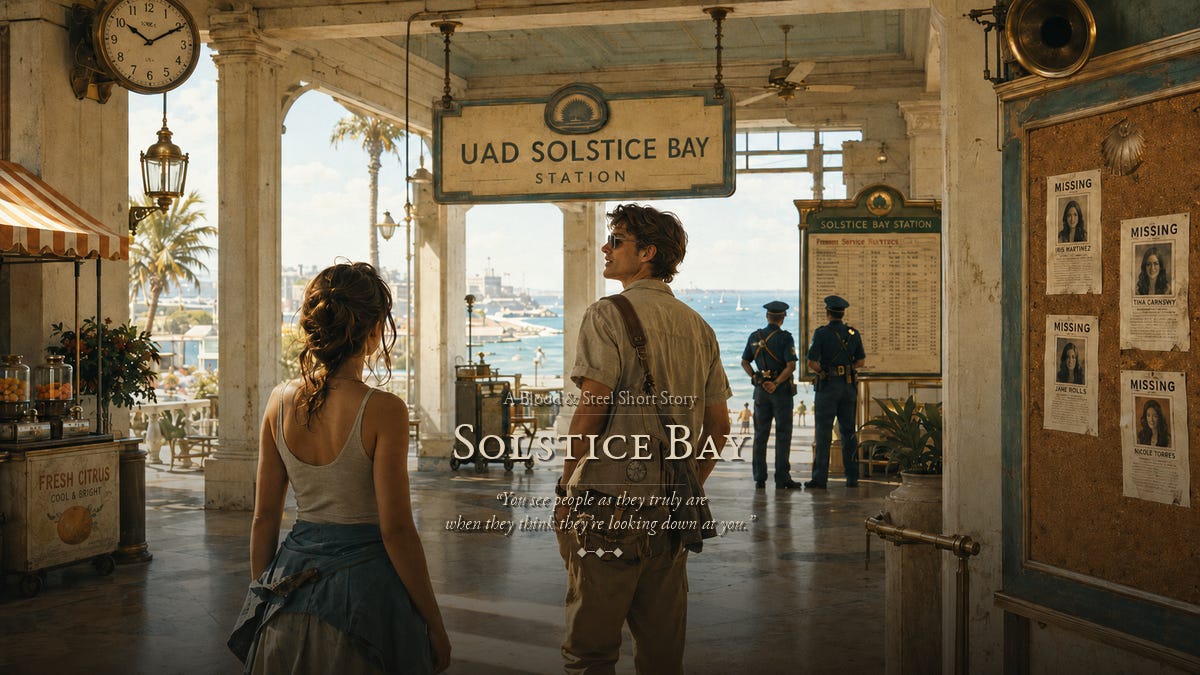
Mid-Summer, 2170 | Solstice Bay Station
The sun hit Solstice Bay Station like it meant it, heat rippling off the polished stone pathway and the white-washed pillars that framed the main entrance. Salt air rolled in from the coast, mixing with coal smoke and the sweet citrus from vendor carts clustered near the plaza. Tourists moved through the terminal in bright, unhurried groups, and the whole place had the feel of somewhere that wanted you to relax, to stay a little longer, to spend a little more.
Charlee Whitmore hadn’t expected to love it here. Three days with Ren in a city that smelled like the ocean and looked like a postcard, and she still wasn’t used to it. Back in Pender County, the coast meant brine and diesel and the constant grind of the processing docks. Here it meant vendor carts selling iced citrus water and couples walking the harbor boardwalk after dark.
She stretched her legs outside the station entrance, jacket tied around her waist, tank top clinging to her back in the humid coastal air. Her dark brown hair hung in a loose twist that she’d stopped bothering to fix somewhere around the second day.
The signage at the station was in transition. Older placards still read SOLSTICE BAY in faded territorial lettering. Newer ones, freshly mounted on brass fixtures, proclaimed UAD SOLSTICE BAY in the crisp format of the Continental Authority. The city had been formally accepted into the Union six months ago. The paint was still drying on the welcome.
“Last chance to skip the train and stay another week,” Ren said, adjusting the strap of his bag.
“Don’t tempt me.” Charlee shielded her eyes against the glare. “I could actually get used to air that doesn’t taste like the docks.”
Ren laughed. “That’s because Pender County marinates everything in fish oil. Including the people.”
Charlee bumped her shoulder into his, which landed somewhere around his ribs. He caught her before she bounced off, the way he always did. Ren was tall, sun-faded shirt stretched across lean shoulders, dark hair that looked careless in a way that probably took effort. When he smiled, people noticed. Charlee had watched it happen enough times to stop being surprised by it.
Two Wardens in dark blue stood near the main information board. One was helping an elderly woman find her platform. The other checked a brass pocket watch, scanning the crowd with an ease that came from doing it every day for years.
Just past the board, a corkboard on the stone wall. Charlee slowed as she passed it, her gaze catching on a row of printed handbills along the bottom edge. Five of them. Six. All the same format: a name, a physical description, a date last seen. No photographs. Just the Continental Authority seal and the word MISSING stamped across the top of each one in heavy black ink.
She stopped. All girls. All young. Most from working-class towns along the bay.
Lissa Corvin, age 19, brown hair, last seen departing Solstice Bay Station, Early Spring 2170. A few months ago. Right here.
Ren glanced at the board, then away. “Those are months old. The Authority handles it.” He nodded toward the Wardens by the information board.
Charlee looked at the posters a moment longer. Girls her age. Girls from places like hers.
“Hey.” His hand on her lower back. “You’re with me.”
She let him guide her away from the board.
“I still can’t believe I’m doing this,” she said. “Meeting your parents. In the capital.”
Ren adjusted the strap of his bag, glancing at the departure board. “Express to CAD Hamilton. Six hours, give or take.”
“I keep imagining your mother inspecting me like I’m one of those bay-town girls from the improvement speeches.” She tucked a strand of hair behind her ear. “Reclamation,” they called it. “Correction.”
He laughed. Two women passing by looked at him, smiled, kept walking. Charlee looked at her shoes.
He tipped her chin up, his thumb brushing her jaw. For a moment he just looked at her, his gaze settling on her eyes. Green-hazel, with flecks of rust near the iris that caught the light when she looked up at him.
“They’ll love you, Charlee. Even if you’re awful at cards.”
She swatted his arm. “Cheater’s fault.”
“ATTENTION PASSENGERS: THE EXPRESS TO CAD HAMILTON WILL DEPART FROM PLATFORM SEVEN IN FIFTEEN MINUTES. ALL PASSENGERS SHOULD PROCEED TO PLATFORM SEVEN FOR BOARDING.”
The announcement exploded from directly above, static crackling through the speaker. Charlee yelped, hands to her ears. Ren flinched, shoulders up around his ears.
Their eyes met. Then they were laughing, moving away from the speaker.
“That’ll come back to haunt me when I’m seventy,” he muttered, rubbing his ear. “Swear they built those things to rupture eardrums.”
She was still laughing, one hand pressed to her chest. “I think I jumped a foot in the air.”
“You did. I’ve never seen someone so small get so much height.” He tucked a strand of hair behind her ear. “My sister Rachel’s meeting us at the station. She’s the welcoming committee.”
Charlee’s laughter faded. “Rachel? I thought you said your sister’s name was Rebecca.”
Something flickered across Ren’s face, so brief she almost missed it. A tightening around the eyes. Then it was gone.
“Oh, Rachel... Rebecca, I mean.” A smile, too quick. “Family nicknames. She’s Rachel to us, Rebecca at school.”
She was certain he’d mentioned Rebecca before. Never a Rachel. “But I thought you said...”
He was already moving toward the terminal entrance. “Come on, let’s get inside before we melt.”
She hesitated. Then followed.
The terminal smelled of oil and steel, coffee from a vendor cart, the salt tang of ocean air. Ceiling fans turned overhead, circulating the humidity just enough to notice. Through the eastern windows, late afternoon sunlight caught the bay, the water stretching out past the harbor toward open sky. The Authority’s seal gleamed on terminal doors, information boards, waste bins. The new ones, at least. Some of the old territorial markers still showed beneath fresh paint, like the city hadn’t quite finished putting on its Union face.
A harbor horn sounded, deep and rolling. Nothing like Pender County’s thin, reedy dock whistles.
“What did you tell them about me?” she asked.
Ren’s expression turned serious. “Well, I told them you’re a black market courier for the mob who specializes in dangerous deliveries.”
Charlee stopped. Her eyes went wide.
“I’m teasing!” He laughed, squeezing her shoulder. But his eyes didn’t match. “You should see your face. No, I told them you’re studying literature and history. That you make the best cinnamon tea I’ve ever had.”
“Your jokes are terrible.” She shoved him.
“Point taken.” He paused. “And I told them you make me want to be better.”
Charlee blinked. “You did?”
“I did.” He squeezed her hand. “It’s true.”
He reached into his pocket, pulled out a small velvet box. “I was going to wait until we got there, but... I want you to have this now.”
Charlee stared at the box. “Ren, what...?”
“It’s not a ring.” He opened it: a silver bracelet, a single charm. A small, flat disc no larger than a thumbnail, the surface etched with a precise geometric pattern. Three concentric circles bisected by a single vertical line. The engraving caught the light with every slight movement.
“My grandmother left us each something before she passed.” His eyes held hers. “I thought you’d want to wear it for my family.”
It was too nice. Nothing a Pender County family could afford. Her fingers trembled as she touched it.
“Ren, no... I can’t. This is too much.”
“It’s not.” He took it from the box, clasped it around her wrist. His grip tightened as he secured it. The silver was cool against her skin, the disc settling flat against the inside of her wrist. “There. Perfect.”
Charlee turned her wrist. Three circles, one line. It looked like a technical schematic, or the cross-section of something mechanical.
“What does the pattern mean?” she asked.
“Old family design,” Ren said. “Nobody really remembers anymore.” He was already moving. “Come on. Let’s find a seat before our train.”
They found an empty row along the east-facing windows. A janitor was working his way down the far aisle, cart rattling, one wheel squeaking against the tiles. He glanced up as they passed, his gaze lingering a beat too long before he looked away and went back to his work.
She sat, smoothing her skirt.
“I need to make a quick stop before our train,” Ren said, glancing toward the restroom signs. “Three cups of that bay coffee finally caught up with me.”
“Now?” Charlee raised an eyebrow. “We just got here.”
“Nature calls.” His hand settled on her shoulder. Stayed there. “Wait here? I won’t be long.”
She rolled her eyes but settled onto the bench. “Fine. Don’t vanish on me.”
Ren leaned down, kissed her temple. “Wouldn’t dream of it,” he said softly. “You’ll be fine.”
He straightened, smiled, turned away. A few steps out, he paused at a nearby bench, scooped up a crumpled wrapper someone had left behind, and tossed it in a clean arc toward the nearest waste bin. It went in without touching the rim.
“People shouldn’t litter,” he said over his shoulder. “So disrespectful.”
Then he disappeared past the Restrooms sign.
She watched him go. A seamstress’s daughter from Pender County and a university official’s son from the capital. Like something from the novels she loved to read but had never expected to live.
Charlee waited, turning the bracelet on her wrist, thumb tracing the etched disc. A Warden passed her bench, nodded, continued on.
Outside the eastern windows, the bay sparkled in the late afternoon sun. Fishing boats, a passenger ferry cutting a white line toward the harbor mouth. She watched them move across the water and wondered what it would be like to keep going, past the breakwater, past the horizon.
A father held a sleeping toddler against his shoulder. The man looked down at his child with an expression that made Charlee look away. She found herself wondering if Ren would be that kind of father someday. If anyone from a place like Pender County ever got to be that kind of anything.
Her mother’s voice came to her, unbidden: You see people as they truly are when they think they’re looking down at you.
She checked the hallway. Checked her watch.
Twenty minutes passed. No Ren. Her foot tapped. The terminal was quieter, travelers thinning out with each departure. Hadn’t there been evening trains?
She shook her head. He’d be back.
Thirty minutes. She checked the hallway again. Checked her watch again. The vendor carts were packing up. The platform benches emptying. When had that happened?
For one awful moment, the thought came plain and childish: he had left her. Not been hurt. Not been delayed. Left. With her ticket. With her identification. With the bracelet still cool on her wrist and his grandmother’s pattern pressing into her skin. She could picture him on some other platform, bag over his shoulder, already forgetting the way she’d laughed at the speaker, already forgetting her name.
No. Something was wrong. Something had happened to him.
The janitor was nearby, emptying a bin near the east windows. He straightened when he saw her looking at him, and for a moment their eyes met. He glanced at her wrist. Not her face. Her wrist.
But the Wardens were right there by the information board, blue coats visible beneath the Authority seal, brass buttons polished. The whole weight of the city behind them.
Charlee stood, smoothed her skirt, walked toward them.
“Excuse me,” she said, her voice smaller than she intended. The taller Warden turned.
“Yes, miss?”
“My name’s Charlee... Charlee Whitmore. I’m supposed to be traveling with someone, but I...” Her voice caught. “I think something might be wrong. He went to the restroom... I don’t know, forty minutes ago, maybe longer. He hasn’t come back.”
The Warden straightened. “Name of the individual?”
“Ren. His name’s Ren. I...” The words tasted wrong before she finished them. “I just realized I don’t even know his last name.” Her voice cracked. “He had my ticket. My ID.” She looked toward the restroom corridor. “He was right there. Said he’d be right back.”
Saying it aloud made the shape of her fear real.
The Warden nodded. “Remain calm, Miss Whitmore. We’ll check the premises.” He gestured toward his partner, who had stopped his patrol and was watching their exchange. “We’ll conduct a sweep.”
The second Warden approached, producing a brass key from his belt. He unlocked the communication box, the brass latches clicking open to reveal a coiled wire with a speaking device attached. He plugged the wire into a wall jack.
“Have a seat at the far bench,” the first Warden said, indicating a row of seats away from the main boarding area. “We’ll return with information shortly.”
Charlee nodded. “Thank you. I was starting to... thank you.”
She sat at the far bench, hands folded in her lap, bracelet rotating on her wrist. The Wardens were handling it. This was what they were for.
The second Warden spoke into the device, too low to hear. The first walked toward the restroom corridor, boots clicking on the tiles.
The family with the sleeping toddler boarded their train, the child’s face pressed against the window as the doors hissed shut. A group of students hurried toward a departing platform, laughter swallowed by distance.
The vendor carts wheeled away through service doors.
The janitor passed close by. This time, he looked at her. Lips parting. Then he kept pushing his cart, the squeaky wheel trailing behind.
The sun sank lower. Shadows stretched across the terminal floor.
Charlee waited.
She checked her watch. The terminal felt too large. Too empty. The spaces between sounds stretching longer than they should.
Then: footsteps.
The Wardens returned. Charlee straightened.
The shorter one walked to the communication box, unlocked it, spoke into the receiver. Nodded. Glanced at his partner.
The communication box was shut, brass latches clicking into place.
Charlee stood, smoothed her skirt.
The Wardens approached. The taller one met her gaze. Held it. Something different in his expression.
His coat had shifted open. The Authority badge that had been pinned to his chest when she’d first approached him was gone. Not turned around. Not hidden beneath the lapel. Gone. In its place, beneath the collar of his shirt, a chain she hadn’t noticed before. A small medallion, dark metal, resting against the fabric.
“Did you find him?” she asked. “Do you have any news?”
The Warden with the key tucked it back into his belt. The taller one stopped in front of her. His gaze moved across her face and settled on her eyes the way Ren’s had outside, with the same quiet attention.
“You stayed,” he said. “Good girl.”
“What?” She stepped backward. Her eyes went to the chain at his collar, then back to his face. “What about Ren? Did you...”
“Where is he?” she demanded. “If this is some kind of Authority procedure...”
“We’re not Authority.” He lifted the medallion free of his collar. Not the Authority seal. A pattern of interlocking links stamped into blackened brass.
Her gaze dropped to the medallion. Then to the bracelet on her wrist. The geometric disc. Three circles, one line.
She didn’t understand the connection. But she understood enough.
Charlee bolted.
She ran for the main exit, the glass doors reflecting the last light from the bay. Her feet slipped on the tiles. She kept her balance.
Strong hands caught her before she reached the doors, yanked her back. Her water bottle hit the tiles, spilled.
“No!” She fought, clawing, kicking. “Help! Somebody help me!”
Her voice echoed through the empty terminal. Faded. No one left.
“Please,” she gasped. “Where’s Ren?”
“Questions later,” one of them said. “You have something we need.”
Her heels scraped the tiles. She fought, kicking, twisting. Her hair came loose from its twist, fell across her face.
They were stronger. So much stronger.
As they reached the service door, Charlee caught one final glimpse through the glass walls. The bay. The horizon. The last of the sun on the water.
Then the door closed behind her.
The terminal fell silent. Ventilation hummed. Waves lapped faintly against the harbor breakwater.
A water bottle lay on its side near the far bench, a dark stain spreading across the polished tiles. A few scuff marks traced an arc toward the service corridor. A copper hairpin on the floor, catching the last light.
The janitor returned with his cart, the wobbly wheel squeaking in the empty space. He paused when he saw the water bottle. Looked toward the service corridor. Looked away.
He mopped the spill, collected the hairpin, and moved on.
Outside, the sun disappeared behind the bay’s western ridge. The water kept its rhythm.
The new signs still read UAD SOLSTICE BAY in the Authority’s crisp lettering. The corkboard near the main entrance still displayed its row of handbills, each one bearing a name, a description, a date.
Soon, there would be one more.
Solstice Bay is set in the Blood & Steel universe. Explore the world, the characters, and the series at bloodandsteel.netlify.app.